
Portuguese Egg Tarts is an absolute must-try when you travel in Portugal. In Lisbon, people queue for them. The pastry shatters when you bite in, the custard inside is barely set, and the top has dark, almost burnt spots that taste like caramel. They are called pastéis de nata, and once you have had a fresh one, the ones in supermarket boxes just don’t compare.
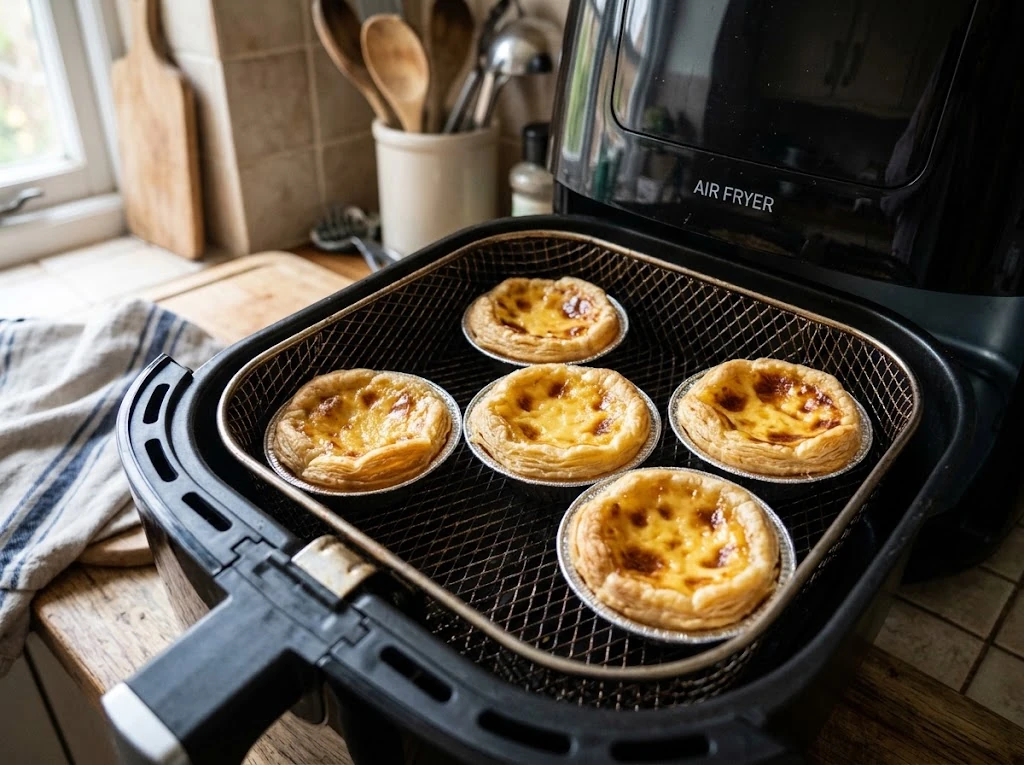
The good news is that you don’t need a bakery oven, or even any oven. These Portugese egg tarts use shop-bought puff pastry and a custard made in one small saucepan. The air fryer does something a normal home oven struggles with: it blasts hot air straight onto the custard, which gives you those dark spots in about twelve minutes.
Ingredients you really need
Makes 6 tarts
For the pastry
- 1 roll of ready-rolled puff pastry, about 230 g, from the chilled section
- 2 ml neutral oil for greasing the tins, or a few sprays from an oil spray bottle
For the custard
- 3 egg yolks (about 55 g)
- 180 ml whole milk
- 50 g sugar
- 10 g cornflour (1 tablespoon)
That is the whole list. The cornflour is the trick that makes this work at home. Portuguese bakeries thicken their custard with flour and a hot sugar syrup, which is fiddly and easy to get wrong. A spoonful of cornflour gives you the same silky, just-set result with none of the stress.
Use whole milk, not semi-skimmed. The fat is what keeps the custard creamy instead of rubbery.
Ingredients that are nice to have
- Double cream, 60 ml, instead of 60 ml of the milk. It makes the custard richer and a little softer. With milk only, the tarts are lighter and still very good.
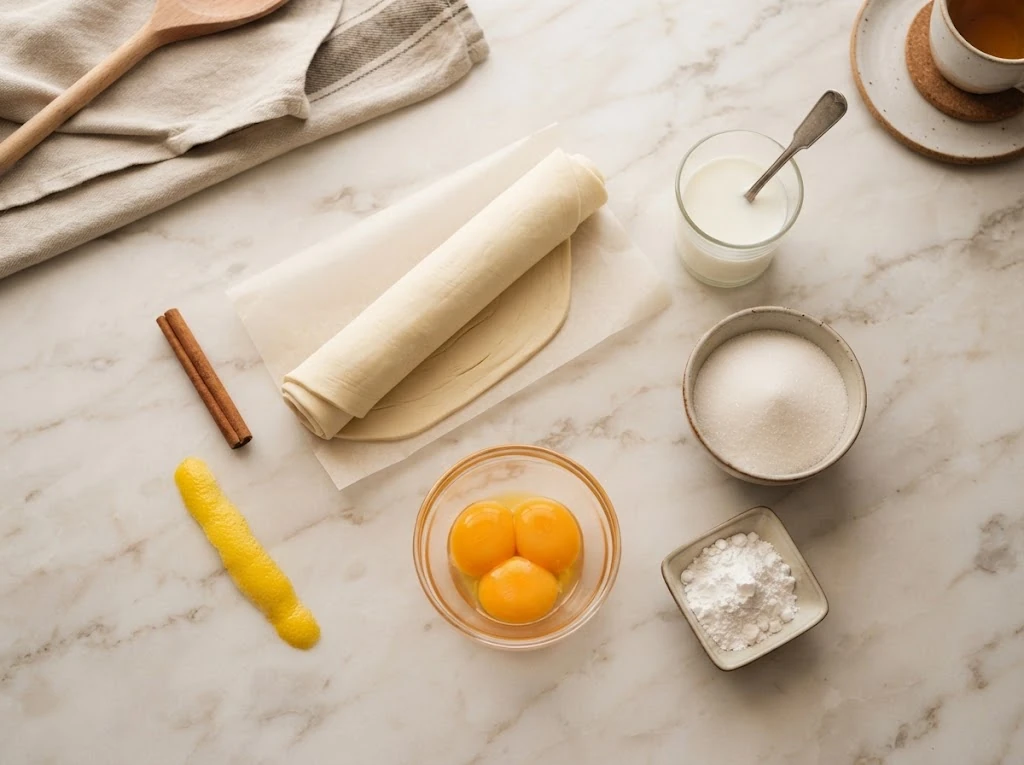
- 1 cinnamon stick and 1 strip of lemon peel (about 5 cm). This is how Portuguese bakeries flavour their custard. Warm them in the milk for 5 minutes, then take them out before adding the cornflour. It adds a soft background perfume.
- Ground cinnamon, 1 g (½ teaspoon), for dusting. In Lisbon it comes in a shaker on every café table.
- Vanilla extract, 2 ml (½ teaspoon). Not traditional, but nice if you like a sweeter smell.
Tools you really need
- An air fryer. A basket of 4 litres or more fits six small tins at once. With a smaller one, bake in two rounds.
- 6 small tart tins, about 7 cm wide. Disposable foil tart cups are cheap and fit well in an air fryer. Silicone muffin cups also work.
- A small saucepan and a whisk.
- A round cutter or a glass, about 9 cm wide, for cutting the pastry circles.
Tools that are nice to have
- A kitchen scale. There are only four ingredients in the custard, so the ratio decides everything. Too much milk and it never sets, too much cornflour and it turns into pudding.
- An oil spray bottle. A thin, even layer in each tin means the tarts drop out cleanly, without a puddle of oil at the bottom making the pastry soggy.
Both are on our list of 10 most underrated kitchen tools, and both earn their place for much more than one recipe.
How to make Portuguese egg tarts
- Take the puff pastry out of the fridge 10 minutes before you start, so it unrolls without cracking.
- In the saucepan, whisk together 50 g sugar and 10 g cornflour. Slowly pour in 180 ml milk while whisking, so no lumps form.
- Put the pan on medium heat and keep whisking. After 3 to 4 minutes it will thicken to the texture of runny yogurt and just start to bubble. Take it off the heat straight away.
- Let it cool for 5 minutes, then whisk in the 3 egg yolks one at a time. If the milk is too hot, the yolks will scramble.
- Unroll the pastry and cut out 6 circles, 9 cm wide. Grease the tins lightly, press one circle into each, and push it up the sides so the edge sits just above the rim. Put them in the fridge for 10 minutes. Cold pastry puffs up better.
- Heat the air fryer to 200°C for 3 minutes. Fill each tart about three quarters full, around 45 g of custard each.
- Air fry at 200°C for 12 to 14 minutes. Check at 10 minutes. They are done when the pastry is deep golden and the custard has dark brown spots.
- Let them cool in the tins for 10 minutes. The custard keeps setting as it cools. Dust with cinnamon and eat them while still warm.
Why Portuguese egg tarts get the dark spots
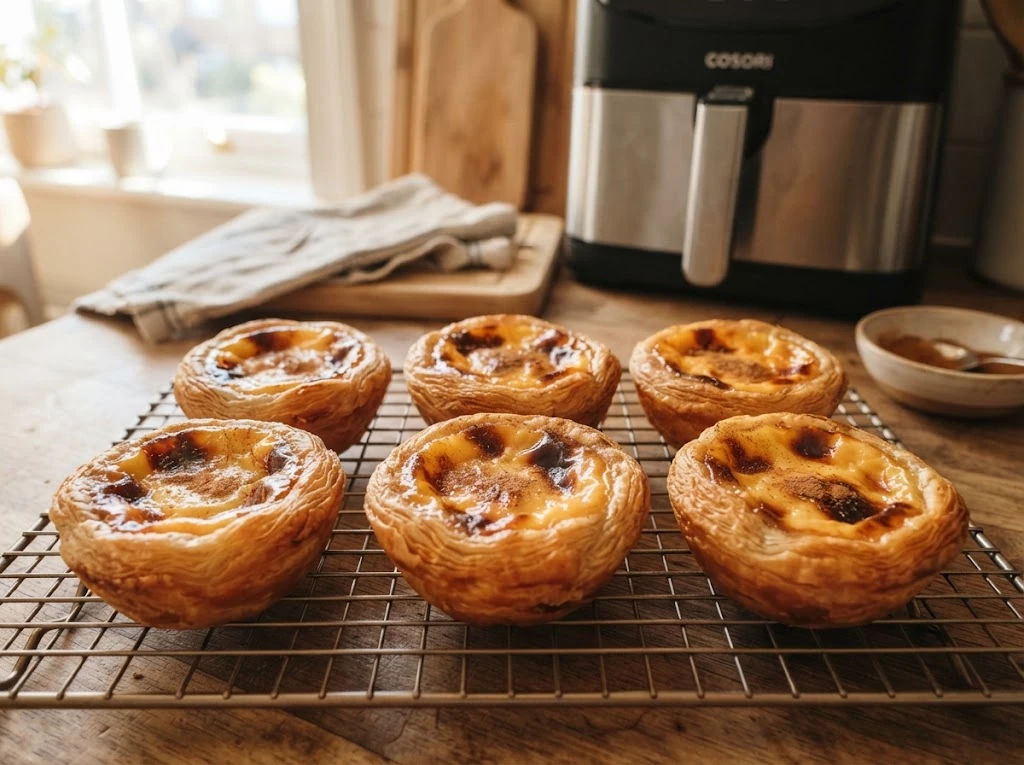
Those dark spots are the whole point of a pastel de nata. Bakeries in Lisbon bake them in extremely hot ovens, far hotter than most home ovens can go, for only a few minutes. The top of the custard caramelises and blisters before the inside has time to overcook. You can read more about the history of the pastel de nata, which started in a monastery in Belém.
A home oven at 220°C bakes gently from all sides, so by the time the top browns, the custard underneath is often dry. An air fryer is a small chamber with a strong fan right above the food. The hot air hits the top of the custard directly, which is exactly what makes the spots. That is why portuguese egg tarts often look more like the Lisbon original than oven-baked ones do.
The same tart travelled far, by the way. Portuguese traders brought it to Macau, where it became the famous Macanese egg tart, and from there it spread across Hong Kong and southern China. It is about as borderless as a dessert gets.
Cooking tips
If the tops brown before the pastry is cooked, turn the air fryer down to 180°C and give them another 3 minutes. Every air fryer runs a little differently, so the first batch of portuguese egg tarts is always a test.
If the custard overflows, the tins were too full. Three quarters is enough, because the custard puffs up while baking and sinks back as it cools.
If the bottom is soggy, the pastry was too warm when it went in, or there was too much oil in the tin. Chill the pastry for the full 10 minutes and use only a thin layer of oil.
If the custard is still runny after cooling, it did not thicken enough in step 3. Next time wait until you see the first bubbles before taking it off the heat.
For more pastry layers, try the Lisbon method. Instead of cutting circles, roll the pastry sheet up tightly into a log, cut it into 2 cm slices, and press each slice into a tin with a wet thumb. The spiral turns into dozens of crisp layers.
Store them uncovered and eat them the same day. Portuguese egg tarts are best within a few hours. To bring a day-old one back, reheat it for 3 minutes at 160°C.
Don’t throw away the 3 egg whites. Freeze them in a small box for up to three months. Coming from the other direction, our spaghetti carbonara recipe also uses mostly yolks, and it relies on the same rule as step 4: keep eggs away from too much heat.

Planning a whole Iberian dinner? Start with our seafood paella recipe from next door in Spain, and finish with these. Or pair them with something savoury from further east, like our Chinese eggplant recipe. Made a batch? Leave a comment and tell us how your spots turned out!